


Robert had a nagging feeling. As CMO of a mid-sized B2B tech company, he’d spent the first half of 2025 pushing his team to adopt AI tools, and it was working—sort of. Usage was up. Efficiency metrics looked good on paper. But something felt off.
Behind the scenes, his senior designer was recreating every AI-generated mockup from scratch. His content lead was anxious about whether his AI-edited content would set off “AI slop” detectors. Two of his best people had quietly admitted that their jobs were “on the line” because AI could generate creative concepts in seconds.
Robert realized he’d made the classic mistake: he’d enthusiastically adopted AI without stepping back, hearing his team out, and resetting how work gets done.
In November, he hit the pause button. With guidance from his executive coach, he ran a reset exercise to reflect on what was working, what wasn’t, and what needed to change. The insights were clear: the team needed clarity about roles, psychological safety to admit struggles, and better coordination around who was doing what.
But then December hit along with all-consuming year-end chaos. The reset insights? They sat in a Google Doc, untouched.
That’s when Robert’s coach asked a pivotal question: “What’s your system for making this stick?”
He didn’t have one. And he knew that without a system, 2026 would be a repeat of 2025: good intentions, no follow-through, and a team that felt increasingly disconnected.
After pondering how to move forward, he built a playbook. Instead of a 10-page strategy document, he created five simple practices his leadership team would run on repeat—weekly, monthly, quarterly—to turn the reset insights into ongoing action.
Here’s what Robert developed, and how he’s planning to use it in 2026.
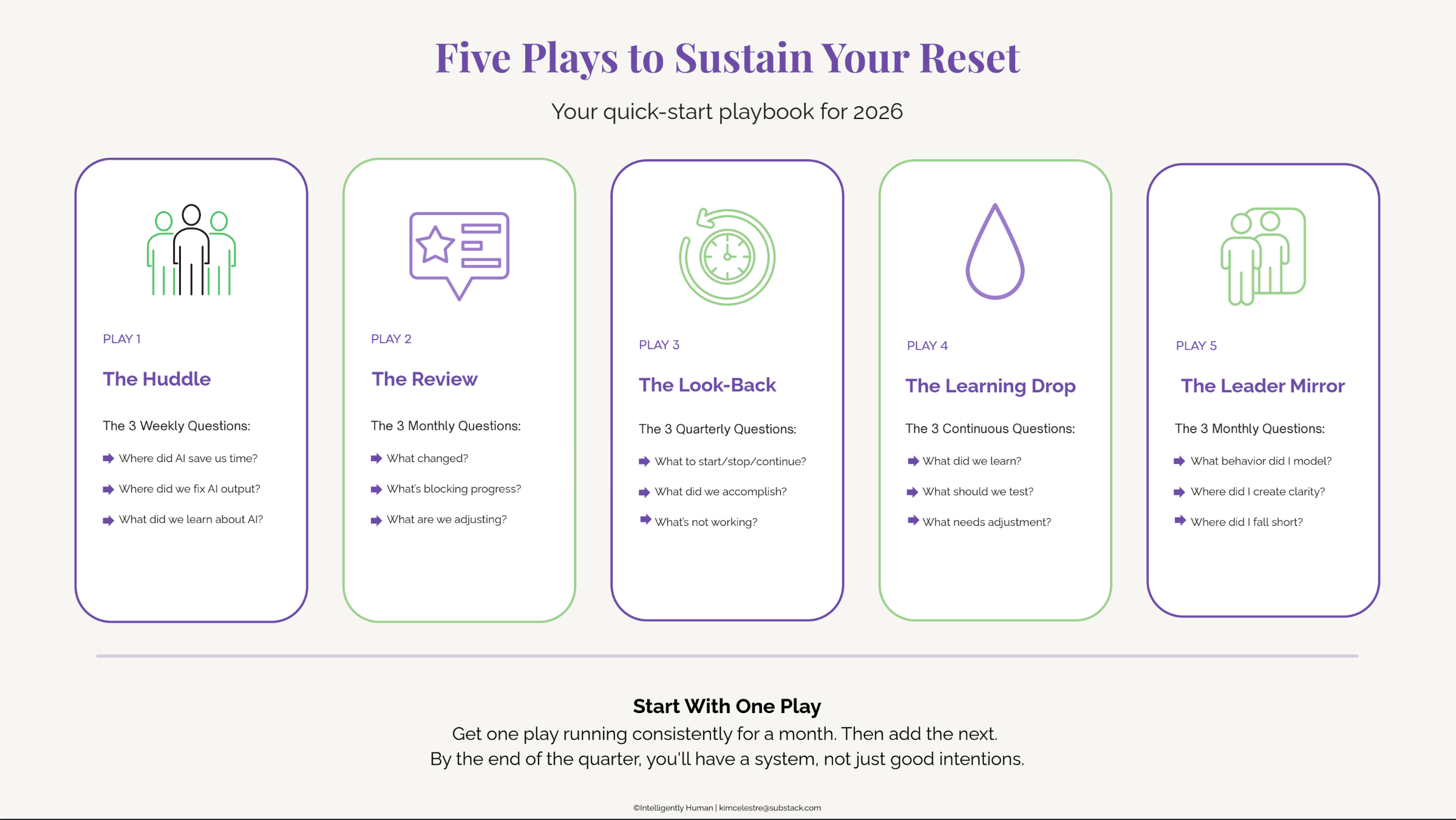
The Five Plays
Play 1: The Huddle
Robert huddles every Friday with the marketing team: 15 minutes, no slides, and the same three questions:
“Where did AI save us time this week?”
“Where did humans have to fix AI output this week?”
“What did we learn about working with AI this week?”
The goal isn’t to solve problems in the moment, it’s to surface them while they’re small and before they become project failures or morale busters. Robert learned that his team was silently struggling, they were fixing AI mishaps behind the scenes, and were anxious about whether they were using tools correctly. The weekly huddle creates a safe space to say “this isn’t working” before it becomes a crisis.
In weekly huddles, Robert listens for anxiety signals (”I don’t know if I’m using this right”), competence gaps (”I can’t tell when AI output is good enough”), and identity concerns (”What is my role if AI can do this faster and cheaper?”).
The setup is simple: same day, same time, with the whole team present. Robert facilitates the discussion but doesn’t lecture. The team talks, and he listens.
Play 2: The Milestone Review
At the end of each month, Robert blocks 30 minutes to review progress against the commitments they made during the reset.
The review structure is straightforward. Robert covers:
“What we said we’d change” – The team reviews the commitments from the reset.
“What actually changed” – They complete an honest assessment of what’s different
“What’s blocking our progress” – They identify obstacles (e.g., resources, skills, clarity)
“What we’re adjusting” – The team modifies approaches based on what they’ve learned
Robert’s biggest learning from 2025: good intentions fade without accountability. The monthly review prevents “set it and forget it” syndrome. It shows the team their input leads to action, and it allows course correction before they veer too far off track.
The trap Robert avoids: turning this into another status report. It’s not about proving they did the work; It’s about learning whether doing the work created the outcome they wanted.
Sample questions Robert asks include:
“We said we’d implement weekly huddles. Are they happening? Are they useful?”
“We committed to clarifying AI usage guidelines. Do people actually know what’s safe to do on their own vs. what needs review?”
Play 3: The Retrospective
Every quarter, Robert blocks 90 minutes for the team to zoom out from weekly tactics and reflect on what’s changing, what’s working, and what needs attention.
The structure:
Start/Stop/Continue – “What should we start doing, stop doing, continue doing?”
Proud moments – “What did we accomplish that we’re proud of?”
Painful moments – “What’s not working that we’ve been avoiding?”
Next quarter focus – “What’s our primary focus for the next quarter?”
Robert’s facilitation approach is to start with proud moments to anchor in the team’s progress, then move to the painful stuff. Instead of avoiding AI failures, they tackle them head-on. That’s where growth happens.
These are sample insights from Robert’s Q4 retrospective:
“We’re using AI more confidently, but we haven’t clarified who owns decisions on new tools to explore.”
“Junior team members still don’t know when to trust AI vs. when to push back”
“Our weekly check-ins are great, but we need monthly deep-dives on specific AI challenges”
With this approach Robert is cultivating a team that can self-assess, self-correct, and self-direct—without waiting for him to notice problems.
Play 4: The Learning Drop
Robert knew knowledge was getting trapped in silos. His senior strategist figured out a brilliant prompt structure that tripled draft quality. His designer discovered a Nano Banana trick that eliminated the “AI stock photo” aesthetic.
None of that knowledge was making it to the rest of the team.
To break down silos, Robert created a Slack channel: #ai-learnings. The task is simple: “Drop one thing you learned about working with AI this week. It doesn’t have to be profound, just useful.”
There’s no pressure to contribute weekly, and no performance metrics are required. The channel is just a living resource where the team documents what’s working. Over time, the channel becomes a knowledge base that helps new hires ramp faster and prevents everyone from solving the same problems twice.
Examples of what gets shared:
“This prompt structure got me 80% usable drafts: [context] + [outcome] + [constraints]”
“Nano Banana tip: add editorial photography’ to prompts for less stock-photo vibes”
“I learned AI can’t do strategy. It doesn’t understand the nuances of our business”
Robert realized that peer-to-peer learning scales quickly when he’s not the bottleneck. And when learnings are celebrated, the culture shifts from pretending how to use AI to openly experimenting with it.
Play 5: The Leadership Mirror
This play is solely for Robert. Once a month, he blocks 30 minutes on his calendar to reflect on his own leadership and identify development opportunities.
Here are five questions he asks himself:
Where did I create clarity this month? (and where did I create confusion?)
Where did I model the behavior I want to see? (and where did I contradict it?)
What did I learn about my team this month that I didn’t know before?
Where am I avoiding a hard conversation I need to have?
What do I need to let go of to lead effectively in 2026?
Looking back on 2025, Robert realized that his team was silently struggling with AI anxiety, identity crisis, and skill gaps. In the meantime, he continued to assertively push his AI agenda in response to board pressure. The Leadership Mirror forces him to admit: he’s navigating this transition too.
Sample insights from Robert’s recent reflections:
“I realized I’m still answering every question instead of encouraging my team figure it out themselves”
“I said I wanted experimentation but reacted badly when something failed. This sends a mixed message”
“I haven’t acknowledged how hard this is. My team needs to hear me say it’s okay to struggle”
What Robert is practicing: self-awareness, humility, continuous improvement. The same things he’s asking of his team.
Robert’s 2026 plan
Robert knows most resets fail because they’re single events, not systems. You have the insight, you make the plan, then urgency takes over and the reset fades from memory.
Robert is sustaining a rhythm:
Weekly huddles surface problems early
Monthly reviews create accountability
The learning channel builds shared knowledge
Quarterly retrospectives zoom out to strategy
His monthly leadership reflection keeps him honest about whether he’s modeling what he’s asking
By March, Robert’s hopeful these plays won’t need explaining, and they’ll become ingrained in the team’s culture. That’s the 2026 promise Robert is making to himself and his team: not a one-time reset, but an ongoing system that keeps them coordinated, confident, and learning despite what AI transformation throws at them.
In 2025, Robert learned that winging it and hoping momentum sticks is a fool’s errand. And he’s not doing that again.
Start with one play
Robert’s advice to other CMOs—don’t try to implement all five plays at once. Pick the one your team needs most right now.
Team feeling anxious? Start with the Weekly Huddle.
Lost momentum from your reset? Start with the Monthly Review.
Knowledge trapped in silos? Start with the Learning Drop.
Get one play running consistently for a month, then add the next. By the end of the quarter, you’ll have a system, not just good intentions.
After piloting the plays in 2025, Robert’s running all five starting January. He’s blocked the time on his calendar, he’s told his team what to expect, and he’s created a “playbook-on-a-page” to keep it simple.
In the spirit of knowledge-sharing, we’ve made it available to you. Download the playbook below and turn your reset into action in 2026!
Next week: We’ll close out December with a look-back at key insights and patterns from the Reflection & Reset series, and what’s coming in January as we shift from reflection into action.
Note: Starting in January, this type of deep-dive content will be available to paid subscribers, so upgrade now so you don’t miss out! If you want to go deeper in your leadership practice, lock in a lifetime access as a Founding Member. As a Founding Member, you’ll also get $200 off the EQ-i coaching bundle.