


Each month, this series follows a fictional composite leader through a real professional challenge. The situations are composites drawn from patterns I observe across B2B marketing teams in AI transformation. The names and companies are invented, but the failure modes are not.
This is the final post in a four-part series following Lena, a composite VP of Marketing at a publicly traded healthcare SaaS company, through the consequences of a restructuring decision that looked right on every metric available. Each post stands on its own. This week: what she changed, what she couldn’t recover, and the conversation she’s been avoiding.
WHAT CHANGED
The session that reframed the work
Lena didn’t open the workshop with the assessment tool. She opened it with a question: What makes this team irreplaceable?
The room was quiet for a moment. Then her content lead said, “buyer fluency”. Her campaign manager said, “the ability to read a healthcare audience’s skepticism”. A junior marketer said she wasn’t sure she’d developed enough expertise to answer the question. That last response stayed with Lena.
The conversation that followed was the first honest one the team had about what AI changed in their day-to-day work, not operationally, but in terms of what they were being asked to learn. Lena brought on the new junior hires for content production. But they didn’t build the domain understanding that made production meaningful.
Lena used the Human Strengths Protection Map to give the conversation structure. The team worked through the eight capabilities together, identifying where expertise existed, where it thinned, and where the restructuring impacted its development. By the end of the session, each person named one strength they wanted to build and one way Lena could support their development.
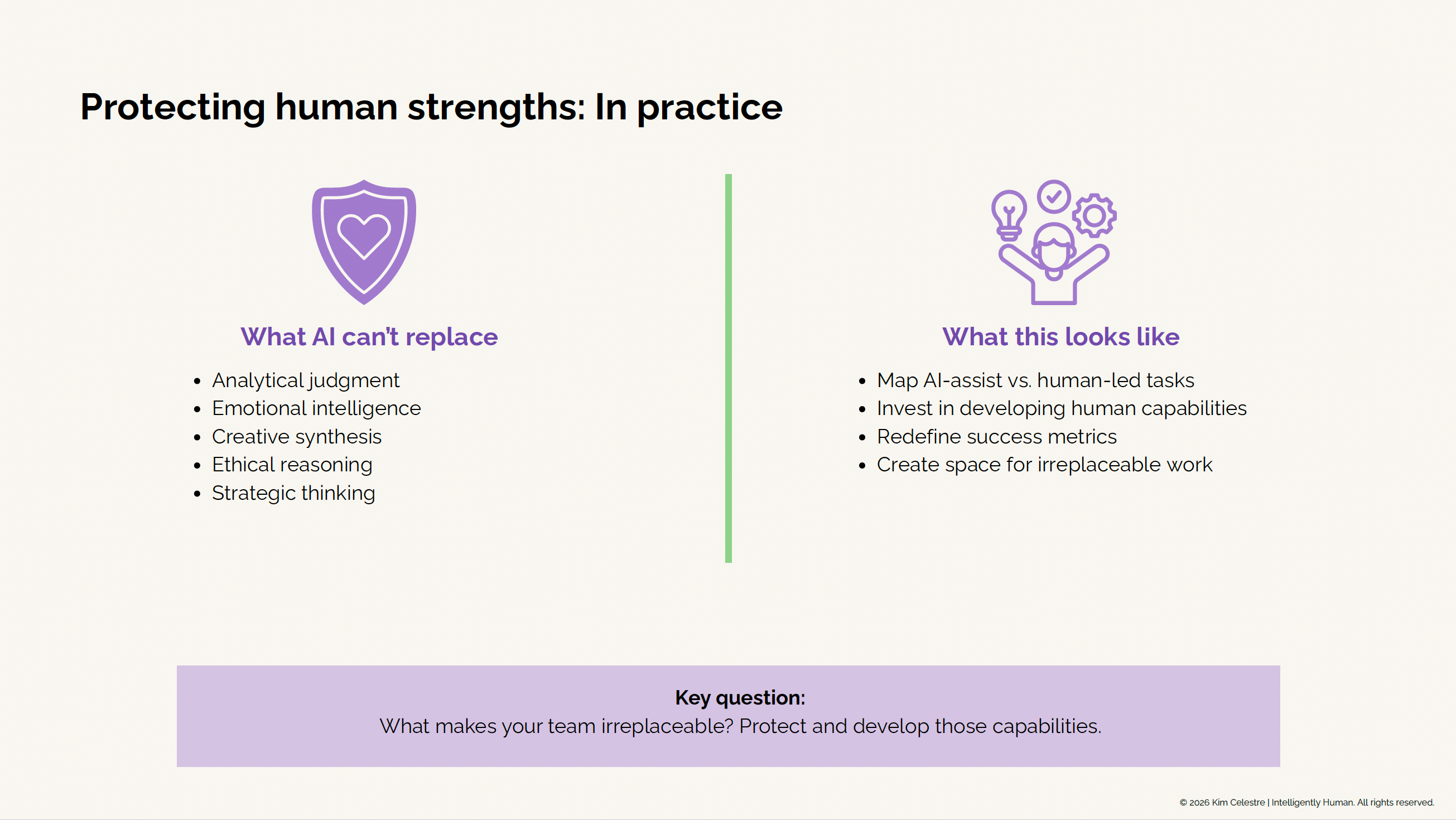
This visual is drawn from the Five Disciplines framework. Paid subscribers receive the full Human Strengths Protection Map — a one-page assessment tool for identifying which capabilities your team needs to protect and develop before AI reshapes the work.
The session delivered something more durable than a governance process: a team that understood what it was trying to protect, and a leader who made visible commitments about how she would help them do it.
Two weeks later, one of the junior marketers flagged a case study draft before it reached final review. The positioning implied a clinical outcome that the product couldn’t deliver. The marketer caught it because she knew the question mattered, not because anyone told her it did.
WHAT SHE COULDN’T RECOVER
The cost of rebuilding from scratch
In March, Lena brought in a fractional healthcare content specialist for a three-month engagement. The scope was deliberate: not production support, but knowledge transfer. The specialist sat in on buyer conversations, debriefed the junior team afterward, and documented the judgment calls the original specialist made but didn’t record.
It was the right structural decision. It was also slower and more expensive than retaining the specialist who was laid off during the restructure. Lena struggled to explain this to her CFO without sounding like she was relitigating a closed decision.
The three enterprise deals that stalled in Q1 were still in motion. Two moved deeper into the evaluation stage. Lena’s team remained in contention, but she had no way to measure whether the relationship was genuinely recoverable or whether the competitor being evaluated had already established the trust that would eventually close the deal. Her pipeline reports tracked stage and deal velocity, but there was no metric to track a buyer’s confidence in the team’s expertise.
That was the cost of restructuring for efficiency. Now she had to rebuild her team from the outside in.
WHAT REMAINS UNRESOLVED
The conversation she’s been avoiding
By the end of April, the team had a clearer sense of what they were trying to develop and a structural path for doing it. The fractional specialist was three weeks into the engagement. The junior marketer who flagged the case study started asking pointed questions in sprint planning. These were big changes, and they happened faster than Lena expected.
What hadn’t changed was what Lena said out loud about the decision that made all of this necessary.
She hadn’t told her team that the October restructuring was optimized for efficiency at the cost of lost domain expertise. She hadn’t shared that with her CFO, who approved the layoffs. She hadn’t shared it with her CMO, who assumed all was well based on the performance metrics.
She knew what the restructuring cost. The team knew it too, through the daily friction of doing work without the deep expertise to do it well. But neither side addressed this in the same room at the same time.
That is where Discipline #3 reaches its limit. The Human Strengths Protection Map gives a leader the language to see what’s at risk. Running the session gives a team the structure to name the strengths they need. But these actions don’t require a leader to stand in front of the people who absorbed the consequences of a bad decision and say what she would have done differently.
Lena knows what the restructuring cost her team. She has yet to say this out loud, to them or to the leadership that approved her decision.
May’s discipline starts with a different leader facing the same question: what does it cost to say the truth out loud?
Thank you for following Lena’s story through April. The EQ in Action series continues in May with Discipline #4: Lead with Cultural Honesty.
If this series has been useful, share it with a marketing leader navigating the same terrain.