


Every few decades, the fundamental rules of leadership change. Throughout my 20+ years as a marketing leader, advisor, and coach in Silicon Valley, I’ve lived—and thrived— through all of these changes:
The 1990s demanded global thinking as markets opened and supply chains stretched worldwide. My perspective shifted from US-centric marketing to developing GTM strategies that drove awareness and consideration in international markets.
The 2000s required digital fluency as the internet transformed how we reached customers. I began my career in this timeline, and the rapid rise of social media and online communities launched a period of experimentation with new ways of engaging with B2B buyers online.
The 2010s rewarded data-driven decision-making as analytics became table stakes. This was my Forrester analyst era, dominated by client conversations about adopting data-driven marketing leadership, embracing research-backed buyer journeys, and exploring marketing attribution modeling.
2026 is another one of those moments.
Here’s what most marketing leaders don’t realize: the shift happening right now isn’t about adopting shiny new tools or learning the “latest and greatest” platforms. It’s about developing an entirely different leadership operating system that prioritizes human judgment in an age of machine capability.
Most leaders are still playing by the old rules. They’re optimizing for speed when they need judgment. They’re scaling when they need restraint. They’re building technical fluency when they need human discernment.
The gap between what worked and what’s required has never been wider.
Four forces are converging in 2026
This isn’t hyperbole. Multiple forces are converging right now that make 2026 a true inflection point for marketing leadership:
Force 1: AI reaches critical capability
We’re moving past the AI pilot stage. AI agents are evolving from “interesting experiment” to “operational reality” at mind-boggling speed. According to McKinsey’s November 2025 report, over 70% of current skills remain relevant, but how we apply them is changing. Leaders now face decisions about when to automate, when to augment, and when to keep work fully human. These aren’t technical decisions; they’re judgment calls.
Force 2: Workforce expectations shift
59% of employees fear job displacement due to AI (Edelman, October 2025). And fearful employees look to leadership for signals. They’re watching to determine if their leaders will have their backs, be honest with them, and navigate this transition with empathy and integrity. The trust between leaders and teams is being tested like never before.
Force 3: The AI value gap widens
Only 5% of companies capture AI value at scale (BCG, October 2025). The other 95% are failing not because of bad technology, they’re failing because of bad leadership: leaders who chase scale indiscriminately, who automate without strategy, and measure output over quality of judgment calls.
Force 4: Complexity is the norm
Between geopolitical uncertainty, economic volatility, technological disruption, and generational workforce differences, complexity is a permanent operating environment. Leaders can no longer rely on old frameworks that were built for stability.
These forces aren’t siloed challenges. They’re converging, and traditional leadership approaches—optimizing for speed, scale, and efficiency—break under the weight of this convergence.
Leadership assumptions that no longer work
Let’s be clear about what’s ending, not because these leadership approaches were wrong, but because the context changed:
Speed over judgment
When moving fast meant competitive advantage, speed won. Now? Moving fast without human judgment means automating the wrong things, eroding trust, and stripping meaning from work. It also risks your brand and reputation. Just search the latest high-profile AI mishaps from global brands, and you’ll have plenty of conversation starters to use at your next networking event.
Scale over meaning
For many. years, growth at all costs was the answer. Today, AI makes scaling cheap(er). The differentiator is no longer how much you produce; it’s whether what you create matters to your audience. It’s whether you’re churning out AI slop instead of human-authored perspectives. It’s whether you’re providing the best experience for your customers who value meaningful interactions.
Efficiency over trust
Optimizing every process made sense when trust was stable. However, when 59% of your workforce fears displacement by AI, efficiency without transparency undermines the foundation you’re building on. “Trust is the new currency” not only applies to the responsible use of AI. It also applies to the humans you are guiding through AI adoption.
Technical fluency over human discernment
Learning platforms and tools were essential. They still are. Today, technical knowledge is table stakes thanks to countless free resources, online courses, and generative AI. The scarce capability? Knowing when humans—not AI—must make the call. Allowing AI to run on autopilot with no human oversight is the epitome of FAFO.
If these were your leadership strengths, you’re not behind. You just need to evolve them. That’s what this inflection point demands.
The new leadership capabilities
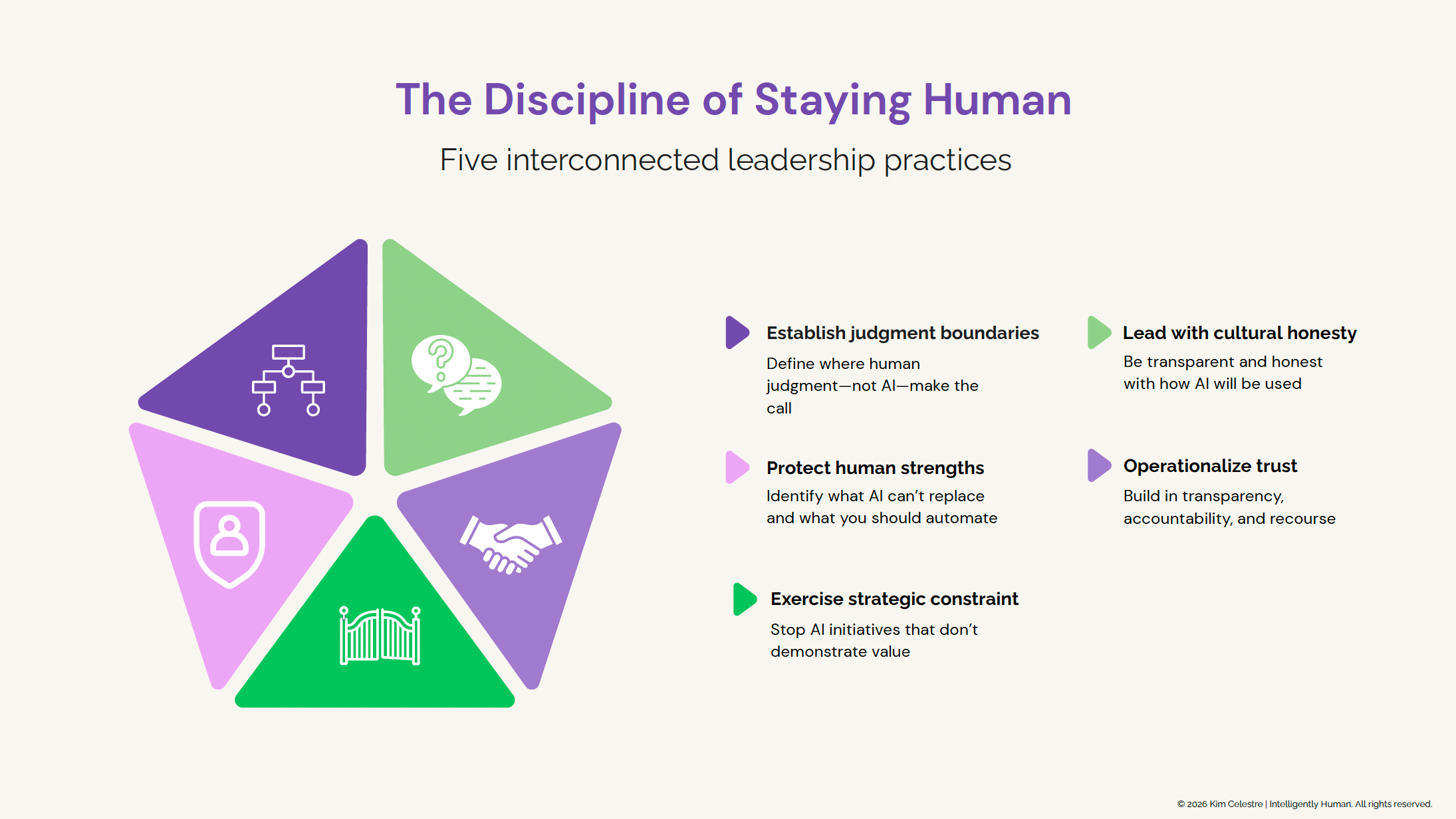
So what replaces the old operating system? Five interconnected capabilities that define human-centered AI leadership:
1. Establish judgment boundaries
Know where humans—not AI—must make the call, not as a philosophical stance, but as architected governance. Leaders must ensure that there is a human in/above/on/behind the loop.
2. Lead with cultural honesty
Provide transparency about how AI decisions are made, where accountability sits, and what happens when systems fail. Skipping this emotional work creates silent resistance that kills adoption and derails initiatives.
3. Protect human strengths
Identify what AI genuinely can’t replace—analytical judgment, emotional intelligence, creative synthesis, ethical reasoning—and actively develop and nurture those capabilities instead of letting them atrophy.
4. Operationalize trust
Build transparency, accountability, and recourse into your AI systems, not as brand messaging, but trust by design. Trust that’s aspirational isn’t trust at all.
5. Exercise strategic restraint
Stop AI initiatives that don’t demonstrate clear value. Say no to automation that erodes trust or strips meaning from work. Know when to stop AI, not just when to start it.
These are the new hard skills for marketing leaders.
And unlike technical platforms that change every quarter, these capabilities compound over time.
Your operating system for the next 5+ years
I’ve spent the past few months synthesizing research from WEF, McKinsey, BCG, Edelman, analyst firms, and OECD—plus advised marketing leaders navigating this transition. The result of this work is a practical framework I created to help you develop these capabilities.
It’s called The Discipline of Staying Human: AI Leadership Framework.
The framework breaks down each of the five practices into:
Why it matters (research-backed)
What it looks like in practice
A clear 12-18 month development roadmap
But here’s what the framework doesn’t tell you: Why leaders who move now have a 3-5 year advantage, and what happens to those who don’t.
That’s what I want to cover in the rest of this post—for paid subscribers who are serious about leading this transition rather than just surviving it.
