

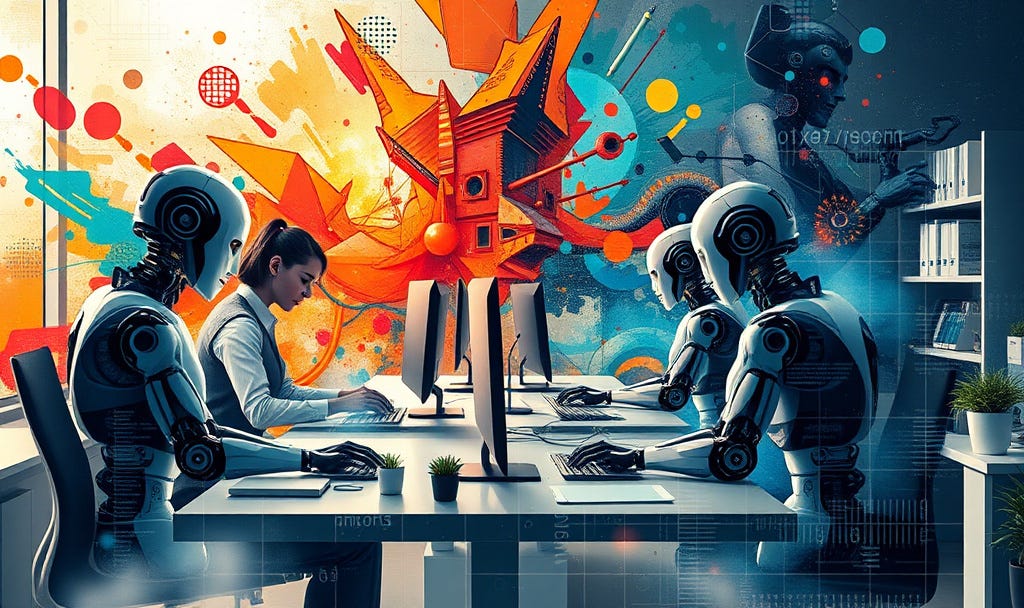
The Hidden Side Effect of Human–AI Teaming
If you find yourself longing for human interaction after hours of conversations with an AI chatbot, you’re not alone. Research shows that working alongside AI can quietly heighten loneliness and fatigue, even as output improves.1
A May 2025 study in Behavioral Sciences found that employees paired with AI felt more drained, unless leaders provided emotional support.2
AI is boosting efficiency, but at an emotional cost.
When Efficiency Erodes Connection
In the race to scale productivity, many overlook the human cost of AI acceleration. When performance rises but human connection fades, emotional fatigue follows.
After spending decades in the tech industry, I’ve observed how new tech advancements alter team dynamics—mostly for the better. But AI flips the team dynamic upside down by replacing entire roles. Sooner than later, your closest colleague may be an AI agent.
Emotionally intelligent leaders mitigate this risk. They prioritize belonging and transparency. They co-design how AI fits into daily work, explain trade-offs openly, and invite dialogue. Teams feel involved, not managed by algorithms.
The next competitive edge won’t come from automating faster. It’ll come from leading with empathy at scale.
Turning AI From Stressor to Stabilizer
Here’s how you can make AI a source of resilience, not fatigue:
Use AI to remove the mundane, not the purpose.
Start with the work that drains creative energy: those dreaded, repetitive, low-value tasks that every marketer would love to off-load. This might mean automating reports or data analysis. When employees see that AI gives them more time for strategic or creative work, skepticism turns into enthusiasm.
Make adoption participatory, not top-down.
Before rolling out new tools, bring teams into the process. Host short Q&As or “AI pilot sessions” where people can ask questions and voice concerns. Publish a plain-language memo explaining what the AI will do, where it won’t be used, and how humans stay in control. Transparency builds trust before metrics add pressure.
Add a human check-in wherever AI steps in.
When AI takes over part of a workflow—writing copy, sorting data, qualifying leads—add a quick “human touchpoint.” Assign someone to ask how the tools are affecting workload, clarity, and connection. These check-ins don’t need to be long; they need to exist.
Final Thought: EQ Is the New AI Strategy
You can’t automate human connection. Without emotionally intelligent leaders, even highly motivated teams lose their spark.
But when leaders scale empathy as intentionally as automation, AI stops being a burnout risk. It becomes a resilience catalyst.
What kind of leader do you want to be?
Chime in: How are you ensuring your teams feel supported and connected as you adopt AI in your organization? Share your experiences by commenting below.
Informed by Harvard Business Review (Oct 2025), Pew Research Center (Oct 2025), Financial Times (Oct 2025)
Meng, Q., Wu, T.–J., Duan, W., & Li, S. (2025). Effects of Employee–Artificial Intelligence (AI) Collaboration on Counterproductive Work Behaviors (CWBs): Leader Emotional Support as a Moderator. Behavioral Sciences, 15(5), 696. https://doi.org/10.3390/bs15050696