


A few months ago, Gartner predicted something that should have stopped every marketing leader in their tracks: a 25–30% drop in search traffic. Separately, Daily Mail’s parent company publicly disclosed losses of up to 89% on certain articles after Google rolled out AI Overviews.
While leaders scrambled to interpret the damage, the real story was simpler and more unsettling: AI didn’t just change the channel mix, it changed how discovery works.
And yet, marketing leadership — structurally, culturally, even emotionally — hasn’t caught up. AI adoption is high. Budgets have ballooned. Roadmaps overflow with pilots. But BCG’s latest research shows only 5% of companies actually extract meaningful value from AI at scale, while 60% see little or none.
The problem? Old assumptions are holding us back.
This is an era defined less by learning AI and more by unlearning the habits that keep us from using it well.
To help you navigate this transition, I’ve developed The Adaptive Leadership Stack - a framework that shows how these three shifts build on each other to create sustainable competitive advantage.
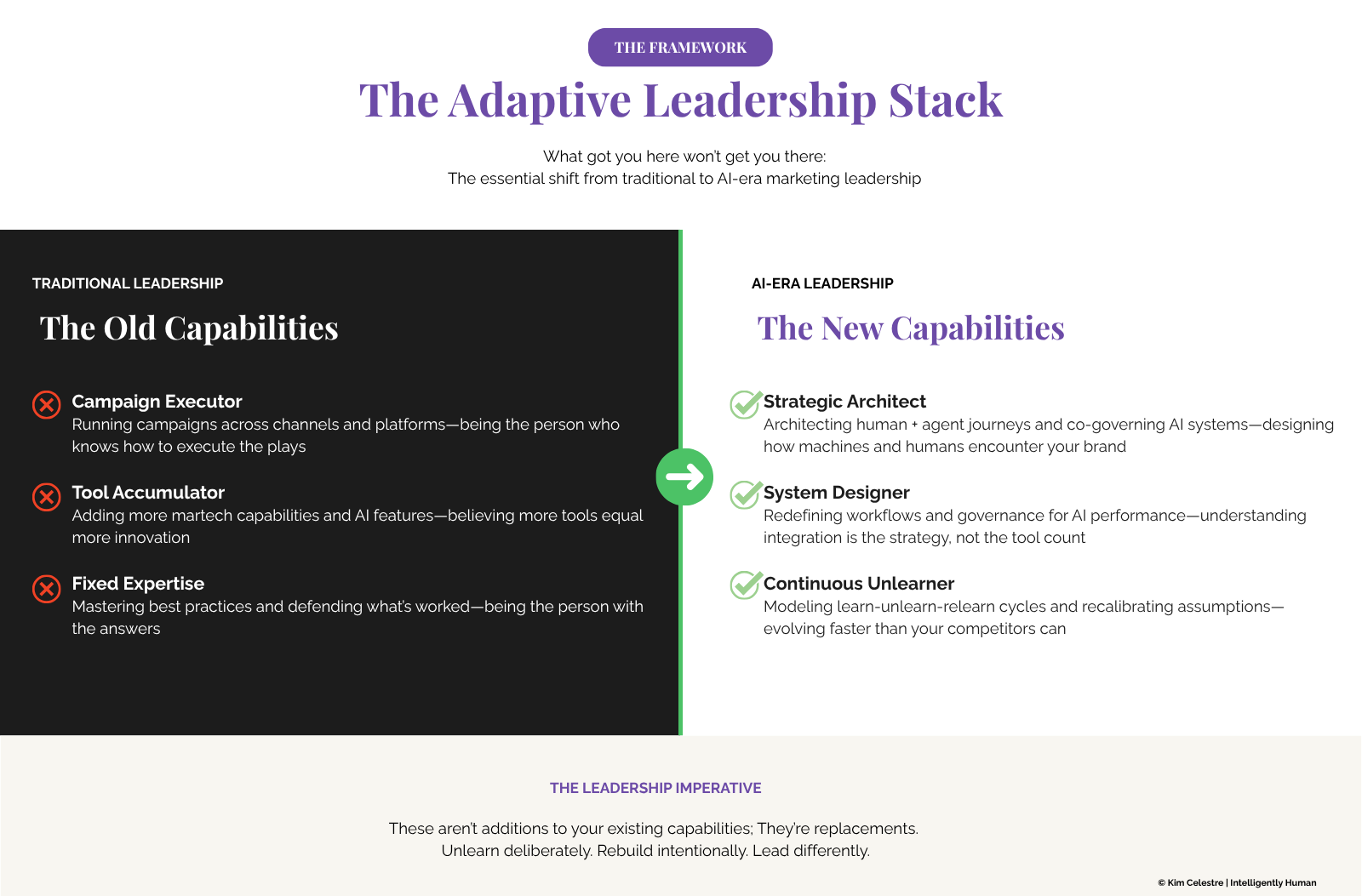
This trio works together:
Shift 1 (Strategic Architect): Changes what you’re responsible for
Shift 2 (System Designer): Changes how you execute
Shift 3 (Continuous Unlearner): Changes who you become as a leader
When integrated, these three shifts create Adaptive Leadership: the ability to evolve with AI faster than your competitors can.
Let’s break down each shift.
Shift 1 — From Executor to Architect
Unlearning: “My job is campaigns and channels.”
Relearning: Architecting human + agent journeys, CMO–CIO co-governance, and AI-native workflows.
AI is now the new front door to the internet. McKinsey found that half of consumers already use AI-powered search, and 20–50% of traditional search traffic is at risk. As discovery moves upstream, happening inside AI systems before people ever reach your site, the CMO’s remit shifts dramatically.
It no longer makes sense to think of your job as running campaigns inside platforms.
Your job is to engineer how humans and machines encounter your brand.
Beliefs to Question
“Search = blue links and clicks to my site.”
“Campaigns drive the journey; channels reach the buyer.”
“Brand strength guarantees visibility.”
“Being top-of-mind means being top-of-search.”
What to Build Instead
Being the answer matters more than getting the click. AI search often cites only 5–10% of content from brand-owned properties. If your content doesn’t answer the question the AI is solving for, you’re invisible.
Governance beats guesswork. CMOs must co-own architectures with CIOs, from data contracts to agent orchestration. This isn’t a “let IT handle it” moment. It’s a “we design this together or we lose control” moment.
AI visibility ≠ brand equity. McKinsey found that category leaders routinely fail to appear in AI answers. Your decades of brand building don’t automatically translate to machine reasoning.
Journeys are now human + agent systems. If AI intermediates discovery, persuasion moves upstream, into the questions people ask and the answers machines surface.
Concrete Capabilities to Develop
AI discovery literacy: Understanding how models source, rank, and cite information
Agentic journey design: Mapping not just touchpoints but the questions AI systems need to answer with your brand
Structured content design: Claims, comparisons, and facts formatted for machine readability
AI-era measurement: Moving from traffic to citation share, decision influence, and no-click conversions
CMO–CIO co-governance: Shared control of data, infrastructure, and AI workflow design
This shift begins with a jarring reality: You’re no longer optimizing for platforms. You’re optimizing for machine reasoning.
Shift 2 — From Tool-Thinking to System-Thinking
Unlearning: “We just need to ‘use AI.’”
Relearning: Redesigning processes, incentives, and metrics for AI to perform.
Most companies are drowning in AI features, yet starving for AI value.
BCG shows it clearly: only 5% of firms achieve meaningful value; the rest swirl in pilots, proofs-of-concept, and decks with more color-coding than outcomes.
McKinsey’s martech study puts a finer point on the dysfunction: among 233 leaders surveyed, none could clearly articulate the ROI of their martech stack. Nearly half cited stack complexity; a third blamed talent gaps.
Your tools are not your strategy.
Beliefs to Question
“More tools = more advanced.”
“If it says ‘AI-powered,’ we’re innovating.”
“Integration will figure itself out.”
“Measurement = dashboards.”
What to Build Instead
AI value comes from strategic workflow redesign, not tool accumulation. The companies winning with AI aren’t the ones with the most tools. They’re the ones who redesigned how work gets done.
Integration is the strategy. Complexity quietly taxes every team until ROI tanks. Every tool you don’t integrate is a tax on your team’s capacity and your ability to see what’s actually working.
Outcomes beat features. Start with revenue, margin, LTV, and churn instead of tool capabilities. Work backwards from business impact, not forwards from vendor features.
Legacy infrastructure is a leadership choice. If half the stack is still running on legacy tech, AI can’t fix it. You’re building the future on a foundation that’s already crumbling.
Concrete Capabilities to Develop
System owner mindset: CMOs as co-architects of end-to-end data and content flow
Value-backwards design: Define outcomes first, then select use cases, then choose tools (not the reverse)
AI orchestration literacy: Understanding agents, orchestration layers, and experiment pipelines without needing to code them
Tool rationalization: Knowing what to sunset, consolidate, or skip
Operational AI governance: Clear ownership of AI workflows, QA, and value tracking
CMOs who succeed in this shift stop asking, “Which tool should we buy?”
They start asking, “What system are we trying to build, and why?”
Shift 3 — From Certainty to Continuous Unlearning
Unlearning: “My expertise is my fixed edge.”
Relearning: Modeling learn–unlearn–relearn and recalibrating outdated assumptions.
Few leadership myths age worse than the idea that expertise is a static advantage.
The pattern is clear across research and industry commentary: leaders who cling to old assumptions lose relevance fastest in periods of technological disruption. As one marketing thought leader puts it: the best marketers today are those willing to unlearn what made them successful yesterday.
The data backs it up. PwC finds 54% of workers used AI this year, but only 14% use GenAI daily, and daily usage correlates with better outcomes. Leaders cannot delegate this learning curve. They must model it.
Beliefs to Question
“The team needs AI skills; I just need directional understanding.”
“Expertise = having the answers.”
“Human vs. AI is a replacement question.”
“My mental model of search/traffic/ROAS still holds.”
What to Build Instead
Leaders must be power users. Daily practice builds credibility. You can’t lead AI transformation from the theoretical level. You need to feel where it works, where it breaks, and where it surprises you.
Your value is in framing, questions, and narrative — not recall. As AI handles more of the “knowing,” your edge shifts to interpretation, strategy, and storytelling.
Humans become more valuable as AI scales. Dentsu’s 2025 CMO report shows 78% believe AI won’t replace imagination; 87% say strategy will require more creativity and empathy. The more AI does, the more distinctly human capabilities matter.
Unlearning is a leadership ritual. When the environment changes weekly, certainty becomes a liability. The leaders who thrive are the ones who can update their expertise constantly.
Concrete Capabilities to Develop
Personal AI fluency: Using GenAI daily for briefs, scenarios, scripts, and synthesis
Critical AI evaluation: Spotting bias, hallucination, misalignment, or strategic irrelevance
Team learning architecture: Institutionalizing experiments, retrospectives, and shared learning
Human differentiators: Empathy, narrative intelligence, ethical judgment
Risk and brand governance: Gartner reports 62% of organizations have already experienced deepfake or GenAI-enabled attacks
The leaders who own this shift aren’t the ones who “know AI.”
They’re the ones who evolve with it faster than their competitors can.
The Pattern: Unlearning Is the New Differentiator
Read across these shifts and a consistent pattern emerges:
Adoption is high; value is concentrated.
Discovery moved to AI systems; Our metrics stayed on websites.
Skills and systems — not tools — are the bottleneck.
This is why the coming divide won’t be between companies that use AI and those that don’t.
It will be between leaders who unlearn quickly and rebuild boldly, and those who wait for certainty that never arrives.
If you want your team, your roadmap, and your results to look different in 2026, start here:
Reframe your role. Rewire your system. Recode your skills.
Everything else cascades from that.
This is the kind of strategic thinking and framework development I’ll be bringing to paid subscribers monthly starting in December. If you want regular access to:
Deep-dive frameworks like The Adaptive Leadership Stack
Practical implementation guides
Monthly strategic briefings on AI + leadership
Consider upgrading to paid when it launches next month. I’ll be sharing more details soon.
Chime in: What leadership capability do you feel you need to shift today and why?