


When teams spend hours reworking AI outputs, when high performers hesitate before hitting send, when customer confidence erodes despite faster responses—that’s the cost of treating trust as a value statement instead of an operational system.
Last week, I referred to this cost as the Trust Tax.
Right now, your team is inventing their own coping mechanisms. They’re creating stealth quality checks, informal approval chains, and private standards for “good enough.” These workarounds feel necessary because the formal systems don’t exist yet.
The Trust Stack replaces those invisible mechanisms with clear operational layers. It’s not a maturity model. It’s not a governance document. It’s the operating system that lets teams move fast with confidence instead of moving fast with anxiety.
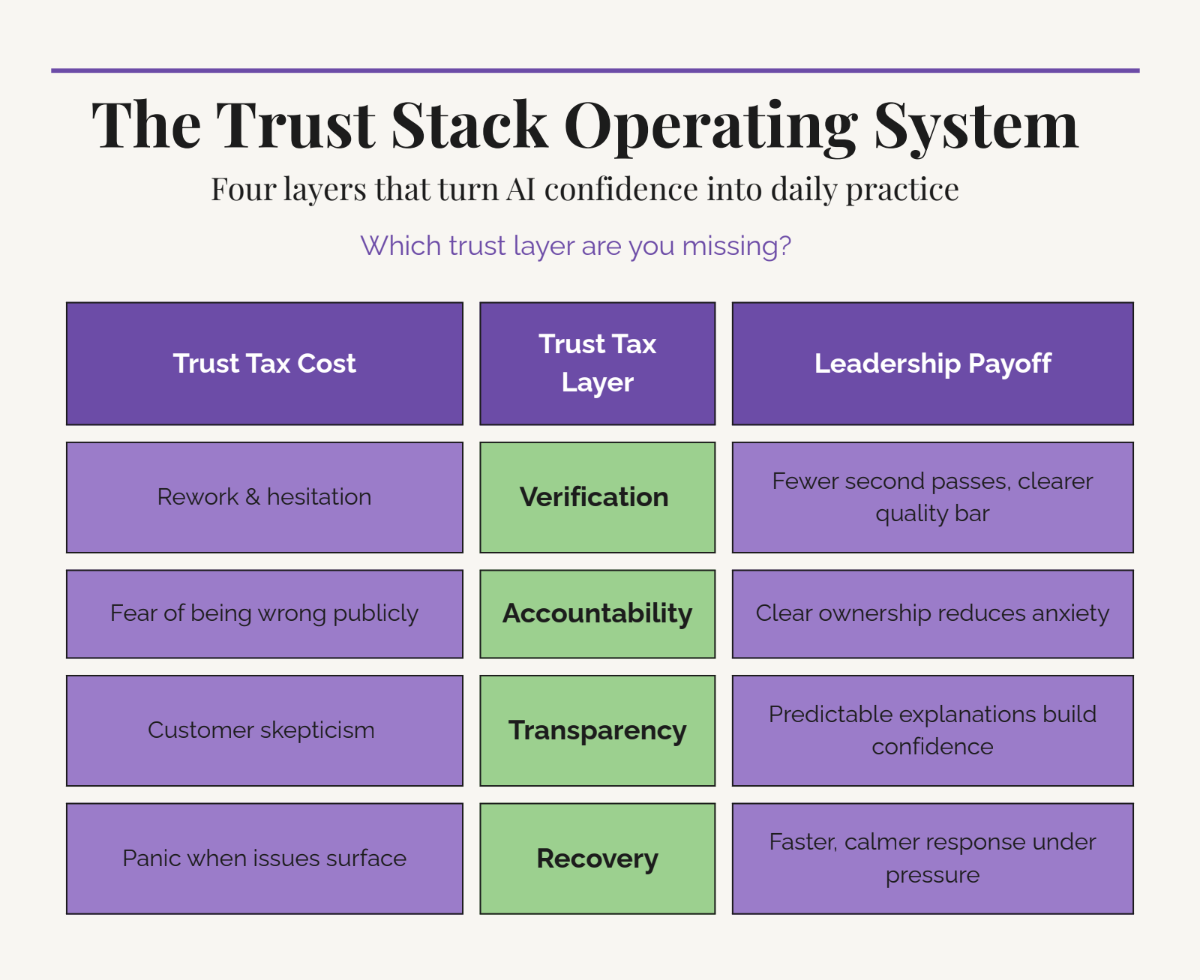
The Four-Layer Trust Stack
Each layer of the Trust Stack addresses a specific trust breakdown from last week. The stacks aren’t sequential. They reinforce each other. You don’t need all four to start, but you need to know which one you’re missing.
The full breakdown of all four layers—plus the one-page framework download—is below for paid subscribers.
