Each month, this series follows a fictional composite leader through a real professional challenge. The situations are composites drawn from patterns I observe across B2B marketing teams in AI transformation. The names and companies are invented. The failure modes are not.
THE FRAMEWORK
Three gates make the authorization mandatory
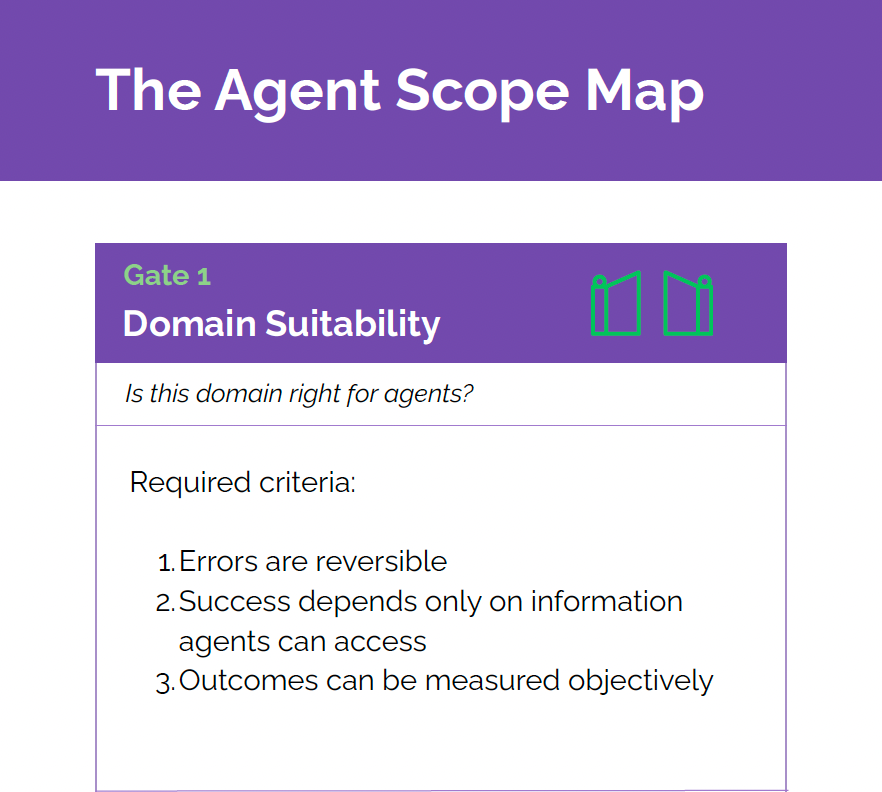
After the customer renewal incident, Nadia had a clear view of her agents’ behavior. The harder question—the one that should have preceded the deployment—was whether agents were the right call for that domain at all. The Agent Scope Map makes that question mandatory.
The tool runs three sequential gates. Each gate holds three binary criteria, and every criterion must pass before advancing. Binary means exactly that: pass or build. An organization that clears two of three criteria in a gate still carries a governance exposure, and the framework treats that as a mandate to build before deploying.
The gate sequence is deliberate. Domain suitability comes first because an agent in the wrong domain carries risk that strong mandate and governance in the later gates cannot fully address. Mandate clarity comes second. Governance readiness follows. Each gate builds on the work of the previous one.