


Last week, I wrote about the three-question cascade your team is experiencing: “WTF happened?” “Will AI take my job?” “Should I quiet quit?”
This week, I’m giving you the framework to interrupt that spiral before January.
This isn’t a strategic planning session. This isn’t a performance review. This isn’t fluff.
The Reset is a 60-minute conversation that acknowledges reality (good, bad, and ugly), creates clarity, and gives your team something concrete to hold onto as 2026 begins.
Keep it simple. No pre-work. No elaborate prep. No slide deck. Just you, your team, and an hour of honest conversation.
Why This Works
This framework is grounded in three coaching principles:
1. Reflection before action. People can’t move forward productively until they’ve processed what actually happened. Skipping straight to “2026 goals” when your team is still reeling from 2025 creates fake momentum, not real commitment.
2. Psychological safety through structure. Open-ended “let’s talk about how the year went” meetings can devolve into venting or silence. Structure creates safety. When people know what’s being asked and why, they’re more likely to engage honestly.
3. Lightweight outputs, real impact. Heavy documentation feels like more work. A simple one-pager feels like clarity. The goal isn’t to create a perfect artifact. It’s to develop shared understanding and tangible commitments.
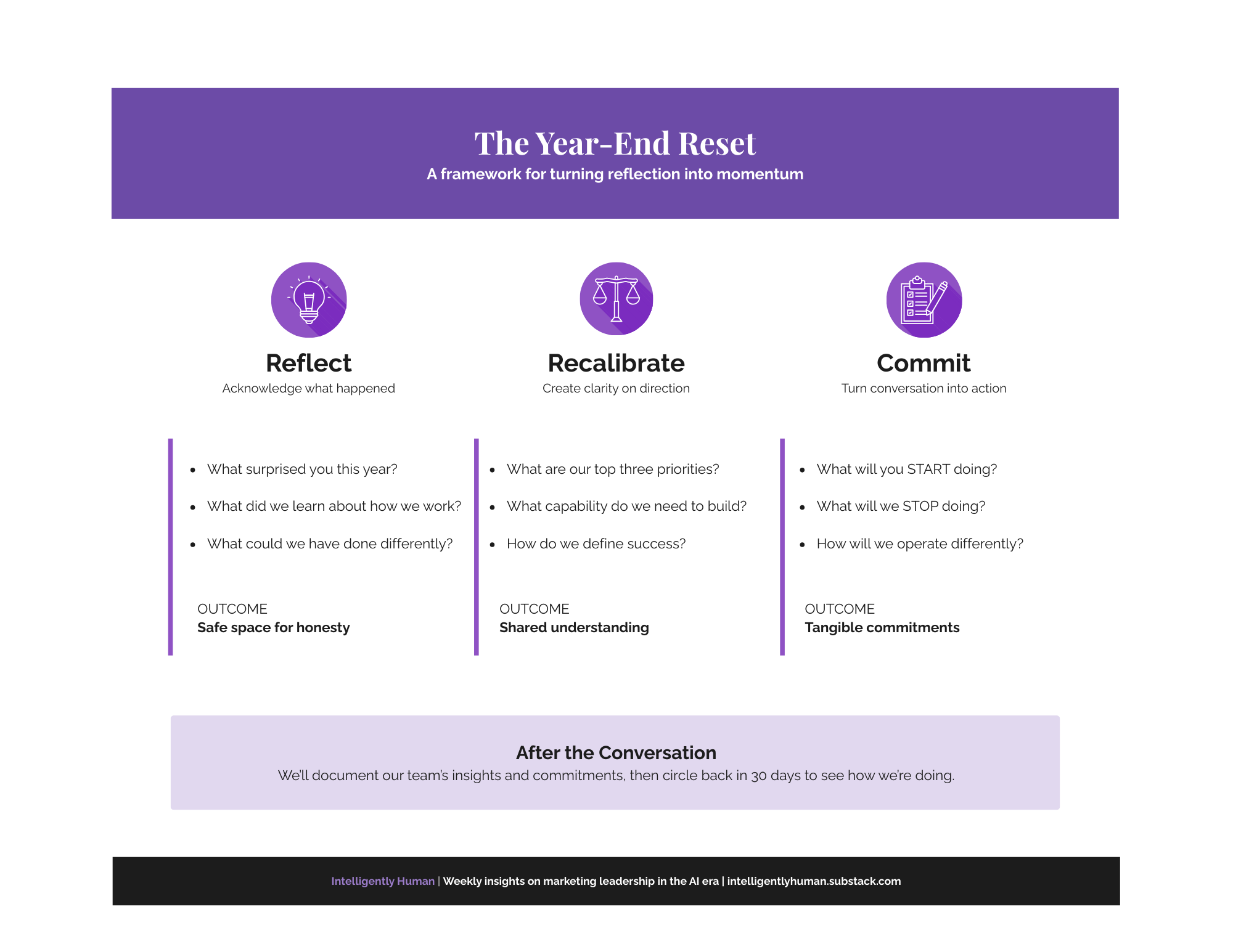
The Framework: Three Phases in 60 Minutes
Phase 1: Reflect Without Defending
Your role: Create safety, not solutions.
The goal here is to let people say “the quiet part out loud”. No defending decisions. No finger-pointing. No explaining why things happened. Just listen and acknowledge.
Opening statement (use your own words): “This year was a lot. Before we jump into 2026, I want us to spend some time talking about what this year felt like and what we learned. This isn’t about blame or justification. It’s about being honest so we can move forward with clarity.”
Three questions to ask:
“What’s one moment from this year that surprised you—good or bad?”
This opens the conversation with something specific and safe
People can choose their comfort level (celebrate a win or name a challenge)
Listen for patterns across responses
“What did we learn about how we work together under pressure?”
This shifts from individual experience to team dynamics
Frames challenges as learning, not failure
Watch for insights about communication, decision-making, and support
“What’s one thing you wish we’d done differently?”
This is the release valve
People need permission to name what didn’t work
Don’t defend. Just listen and capture.
Facilitation tips:
If someone gets defensive or blames others, calmly say: “Let’s focus on what we can control going forward.”
If the room goes silent: Start the conversation. Share your own answers first.
Room still silent? Go around the table (or Zoom screens) so everyone gets a moment to speak.
If someone dominates, acknowledge their contribution(s) and say: “Thanks for that. Let’s hear from others who haven’t shared yet.”
Capture on a whiteboard or shared doc:
Key themes (not everything verbatim)
Patterns you’re noticing
3-5 bullet points max
Phase 2: Recalibrate What Matters
Your role: Translate reflection into clarity.
Now that each person has processed what happened, they need to know where you’re headed. This isn’t a detailed strategic plan. It’s clarity on priorities and how individual work connects to team direction.
Opening statement: “Now that we’ve reflected on 2025, let’s talk about what we’re building toward in 2026. I’m going to share our top priorities, and then I want to hear from you about what needs to stay, go, or evolve for us to be successful.”
Your mental prep (5 minutes before the meeting): Identify your top 3 priorities for Q1 2026. Not everything you’re doing. Just the 3 things that matter most. Be ready to explain why they matter and how they connect to what people actually do.
Three questions to ask:
“How can we align our work around these top three priorities?”
This signals you’re serious about focus
It empowers the team to adjust their workflows and processes
It connects each person to the team’s mission
“What’s one capability or skill we need to develop to be successful in 2026?”
This addresses the “Will AI take my job?” anxiety directly
It frames the future as something to build, not fear
It creates space to talk about AI, new tools, or ways of working
“How will we measure success?”
This quantifies the recalibration
It aligns the team behind the desired outcome(s)
It provides the clarity needed about how performance will be measured
Facilitation tips:
If someone disagrees with one or more of your priorities, remind them of the big picture: “I hear you. These priorities are aligned with the business objectives, will keep us focused, and drive our success in 2026.”
If AI anxiety surfaces: Don’t minimize it. Acknowledge it and be specific about how you’ll support skill development.
If the conversation stays surface-level, ask probing questions: “Let me be more direct—what’s actually getting in the way of doing our best work?”
Capture:
Top 3 priorities for Q1 2026 (write these clearly)
1-2 capabilities/skills to develop
3 key performance indicators to track
Phase 3: Commit to the Reset
Your role: Turn conversation into commitment.
This is where you move from “this could have been an email” to “valuable change-agent.” Everyone leaves with a specific commitment they own.
Opening statement: “We’ve reflected on what happened and clarified where we’re going. Now I need something from each of you: one commitment you’ll make to show up differently in 2026.”
The commitment framework:
Ask each person to share:
One thing I’ll START doing in 2026
One thing I’ll STOP doing in 2026
Rules for commitments:
Must be specific (not “communicate better” but “send weekly updates by EOD Friday”)
Must be in their control (not dependent on other people changing first)
Must connect to the priorities you just discussed
Your commitment: You go first. Model vulnerability and specificity.
Example: “I’m going to START having 15-minute check-ins with each of you each week to make sure you feel supported. I’m going to STOP scheduling back-to-back meetings that leave no time for actual thinking.”
Facilitation tips:
If someone gives a vague commitment, ask for more: “Can you make that more specific? What would I see you doing differently?”
If someone seems disengaged: Pull them aside after (when alone) and ask directly: “What would make 2026 better for you?”
If the energy is low, acknowledge it: “I know we’re all tired. These commitments don’t have to be heroic. They just have to be real.”
Capture:
Each person’s name + their two commitments
Your commitments as the leader
One team-level agreement (“how we’ll operate differently”)
The One-Pager Output
At the end of the 60 minutes, you should have captured:
From Phase 1 (Reflect):
3-5 key insights about everyone learned
From Phase 2 (Recalibrate):
Top 3 priorities for Q1 2026
1-2 things the team is stopping or changing
1-2 capabilities the team is developing
From Phase 3 (Commit):
Individual commitments (each person’s START and STOP)
Team agreement on how they’ll operate differently
What Happens After
Send this one-pager to the team within 24 hours. Don’t let it sit.
Put a 30-day check-in on the calendar before you leave the meeting. Tell them: “We’re going to revisit these commitments in a month to see how we’re doing.”
This isn’t a one-and-done exercise. It’s the start of a reset.
Next week, I’ll share the coaching playbook for sustaining this momentum through Q1. You’ll learn how to have the ongoing conversations that turn this 60-minute reset into lasting change.
But for now? Schedule the meeting. Run the framework. Give your team the clarity they need before January arrives.
Next week: The Q1 Coaching Playbook—How to turn this reset into sustained momentum through ongoing conversations that convert quiet quitters into engaged superstars!